
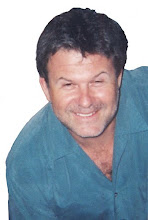
When Newsweek called Barack Obama America's "first gay president" last week for his embrace of same-sex marriage, Fred Karger had to have had mixed feelings.
Karger wanted to be America's first gay president, and not simply in the sense that Newsweek's Andrew Sullivan meant it. Karger is seeking the Republican nomination for president, a long-shot (OK, no-shot) quest that makes him the first openly gay presidential candidate from a major party in U.S. history.
He rolled into Bakersfield last week in a black campaign RV adorned with his smiling, larger-than-life mug and, surrounded by an entourage of one, made an effort to look up some old friends.
He spoke with Stan Harper, who, like Karger, made a name for himself running political campaigns for conservative candidates and causes.
Karger had hoped to meet up with old friend Ed Jagels, the former Kern County district attorney, but to no avail. Jagels led the ultimately successful 1986 effort to oust state Supreme Court Justice Rose Bird and Karger worked on the campaign.
And Karger knows a bit about what former state legislator Roy Ashburn has been going through over the past couple of years, having publicly come out as a gay man later in life himself. Karger, who is 62, made the acknowledgement at age 58.
Ashburn was 54 when the circumstances of a March 2010 DUI arrest in Sacramento essentially forced him to admit what had long been suspected by many.
Karger, who lives in Laguna Beach, says all the things a good Republican would be expected to say about the federal deficit, Obamacare, Medicare and the death penalty, but he swims against the tide on gay rights (duh) and abortion -- he's in favor of a woman's right to terminate a pregnancy.
"A pro-choice Republican, " he says, "is an even narrower niche than a gay Republican." Karger has never held elective office, but he's been on many a campaign trail, having served as a senior consultant to the campaigns of Presidents Ronald Reagan, George H.W. Bush and Gerald Ford. He was also a partner at the Dolphin Group, a California campaign consulting firm. He must be able to read tea leaves pretty well, then, right? So why this quixotic quest? Three reasons, as nearly as I can tell.
He loves tweaking nominee-apparent Mitt Romney for his policy flip-flops and especially for the Mormon Church's position on gay rights. Karger's grass-roots organization, Californians Against Hate, took on the church over its campaign to repeal the state's same-sex marriage law. (Karger's group also waged war on major Proposition 8 donors like Bakersfield's William Bolthouse.) When Salt Lake City is on the phone, Karger maintains, President Romney will take the call every time.
He relishes the fact that his campaign has actually gained a little steam: Karger outpolled Ron Paul in the March 18 Puerto Rico primary, 1.43 percent to 1.22 percent. And now he's the only Republican on the June 5 California ballot who has not formally dropped out and is not named Mitt Romney.
That makes him the last surviving anti-Romney. But the main thing that drives him: He knows that young gays are watching him. "I was walking in an Occupy New Hampshire march and this 15-year-old girl walked up to me, " Karger says. "She said, 'Are you Fred Karger?' 'I am, ' I said. And she said, 'I'm gay.' She shook my hand and just held it; we stood there for maybe 30 seconds and cried a little together. And that symbolized what I'm doing."
His gripe with the Republican Party is that its tent is too small. There's no room for new or different ideas. "It's like you're with the party on every issue, or you're against it completely, " he said. "That's got to change."
Karger is trying to help. Those windmills are tough targets, though.
Showing posts with label Ed Jagels. Show all posts
Showing posts with label Ed Jagels. Show all posts
Tuesday, May 22, 2012


Saturday, April 11, 2009
Documentary misses an opportunity
Bill O'Reilly's favorite actor, Sean Penn, lends his name and voice to "Witch Hunt," airing April 12 on MSNBC. The documentary, by Dana Nachman and Don Hardy, is the story of the six Bakersfield parents who were wrongfully convicted of multiple counts of child molestation in the 1980s. Many locals are undoubtedly well-acquainted with the horrific story, which features names likes Pitts, Modahl and Stoll, so perhaps there is little new knowledge to be gained from the documentary in this part of the country.
But almost three decades after the first arrests, you'd think we were due for some analysis, some historical perspective. The documentary pins much of the blame for the flawed prosecutions on Kern County District Attorney Ed Jagels. But how did he continue to get re-elected by such substantial margins, even after the prosecution's self-inflicted problems became evident? Why didn't anyone ever step forward to oppose him?
Could this only have happened in a community like Bakersfield that tends to assume guilt? Or is it a broader phenomenon?
And where was The Bakersfield Californian in all this? (Answer: Casting more and more doubt on the "molestation ring" as time went on -- something a cursory glance at newspaper archives would have revealed.)
The filmmakers had a chance to study the ingredients of community hysteria. Instead, they seem to have produced a docu-drama that leaves us only with this penetrating question: "Gosh, wasn't that a shame?"
Subscribe to:
Posts (Atom)